The Sunk Cost Trap: How to Stop Throwing Good Money After Bad Campaigns
If you’ve ever said, “We can’t pull the plug now, we’ve already spent so much,” you’ve met the sunk cost trap. It’s the bias that makes smart teams keep investing in underperforming marketing because past spending feels like a debt that future spending must repay. That money is gone. The only decision that matters is whether the next rupee is best invested here or somewhere else.
What the sunk cost trap looks like in marketing
It rarely announces itself. It hides behind phrases like “Let it run until quarter-end,” “We already briefed the new creatives,” or “Procurement will kill us if we cancel the contract.” In practice, it shows up when:
Performance media keeps getting “just one more flight” despite a rising CAC (Customer Acquisition Cost) and flat pipeline.
Sponsorships roll over because “it’s a relationship,” though lift on brand or revenue was never proven.
Content syndication or ABM vendors get renewals on the promise that “this time targeting is fixed.”
MarTech seats and data contracts continue because “we negotiated enterprise pricing,” even if adoption is low.
Each of these rationalizations protects yesterday’s decisions at the expense of tomorrow’s growth.
Why rational teams fall for it
Marketers aren’t irrational; incentives are. Large campaigns accumulate internal champions, vendor politics, training time and leadership expectations. Attribution windows, lagging indicators and quarterly targets make it hard to call a stop in time. And because most marketing value is probabilistic, it’s easy to believe that one more creative refresh will turn the corner.
The core problem “too big to stop”
Problem: A B2B team commits to a six-figure, multi-quarter ABM program. Early indicators look fine (impressions, CTR, MQL volume), but opportunity quality, win rate and payback period are off plan. Instead of halting, the team doubles down add new audiences, expands geos and refreshes messaging because walking away would “waste” sunk spend and signal failure.
Why this is dangerous: Past spending is unrecoverable. Doubling down often crowds out higher-ROI bets (organic conversion fixes, sales enablement, ICP refinement) that would improve pipeline quality and velocity. The real risk isn’t “wasting what we spent”; it’s wasting what we’re about to spend.
The solution - decide like a portfolio manager
Treat live programs as positions in a portfolio, not marriages. Every week ask: “Knowing what we know today, would we start this again at this budget?” If not, reduce or stop then reallocate to the highest expected return.
Here’s a practical, non-fluffy path out:
Set kill criteria on Day 0
Before launch, define tripwires tied to business outcomes, not vanity metrics. Examples: “If blended CAC for this channel stays > 1.5× target after two optimization cycles,” or “If Stage 2→Closed Won stays < 8% for two consecutive months,” we pause and review. Put these in writing. Share them with finance and sales. When the line is crossed, you stop no reputational damage, just rules being followed.
Create counterfactuals to see the real lift
Run holdouts or geo splits so you can observe pipeline or revenue differences with vs. without the program. When you can point to a clean counterfactual, it’s far easier to shut down spend that isn’t moving outcomes.
Re-rank by “next best dollar”
Ask: Where would the next ₹1 create the most expected value? Often, the answer is not “more media.” It’s conversion architecture (fewer form fields, better offer fit), sales enablement (battlecards tied to loss reasons), or ICP tightening. Shifting money here tends to improve pipeline quality faster than squeezing extra impressions.
Separate experimentation from operations
Ring-fence edge bets (new channels, contrarian formats) with small, time-boxed budgets and pre-declared success thresholds. Keep table stakes (search, lifecycle email, website CRO) funded only to the point of positive marginal return. This barbell prevents both stagnation and runaway sunk costs.
Reduce attachment with external reviews
Schedule a quarterly red team review with someone outside the campaign (finance partner, product marketing, or an external advisor). Their job: challenge assumptions, inspect funnel math and ask the uncomfortable “start again today?” question.
Real-world examples (and what they teach)
P&G’s digital ad cuts (widely reported): After reducing large portions of digital spend several years ago, they saw minimal impact on outcomes in the near term and rebalanced the mix. Lesson: if measurable business impact isn’t clear, stopping can surface waste and improve efficiency.
Microsoft’s mobile push: Massive investments in marketing, channels and hardware still couldn’t overcome weak product-market fit; the company ultimately wrote down the effort and redirected resources. Lesson: marketing can accelerate adoption, but it can’t manufacture fit know when you’re compensating for structural gaps.
Pepsi Refresh Project: A highly visible social good campaign generated enormous engagement, but critics argued it didn’t translate to core sales; the brand returned focus to traditional brand building. Lesson: engagement ≠ revenue; if your core objective is sales, optimize for sales.
These examples underline one theme: stopping is a strategy. The value came not from persistence but from disciplined reallocation.
How to know you’re already in the trap
You may be caught if your updates sound like: “Awareness is up, but the pipeline will follow,” or “Let’s run one more creative cycle,” or “We’ll lose momentum if we pause.” If you cannot answer, with data, how this initiative improves revenue velocity within a defined window, you’re rationalizing sunk costs.
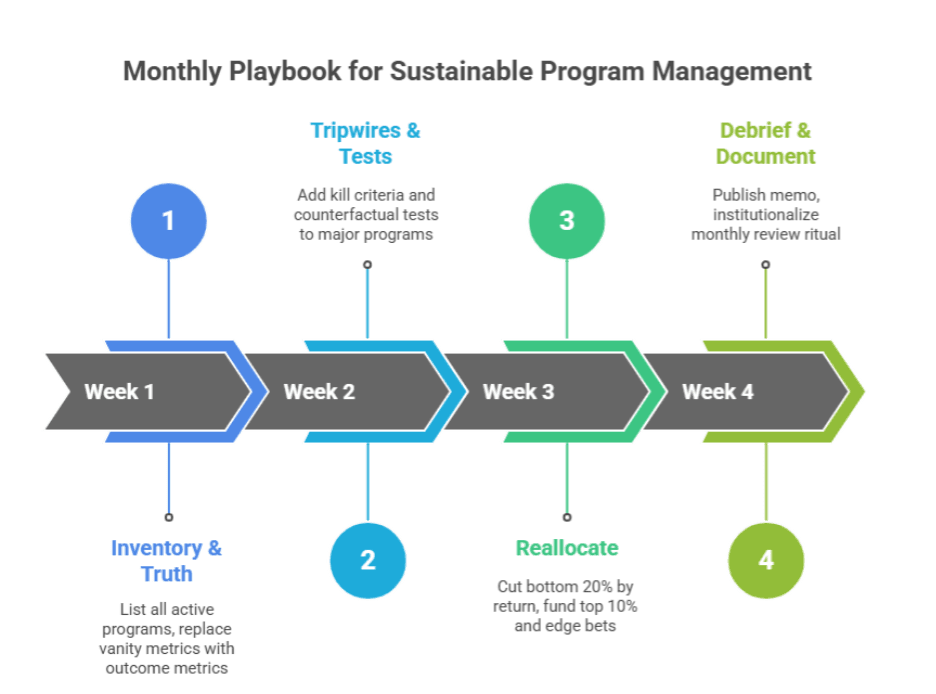
A playbook you can run this month
Week 1 - Inventory & truth: List every active program with its original hypothesis, budget, and the business metric it promised to move. Replace vanity metrics with outcome metrics (payback period, opportunity-to-win, MER, contribution margin).
Week 2 - Tripwires & tests: Add explicit kill criteria and at least one counterfactual test per major program (geo holdout, audience split, or time-based blackout).
Week 3 - Reallocate: Cut the bottom 20% by expected return. Move the money to your top 10% (usually CRO, lifecycle triggers, or ICP-focused sales enablement) and to one or two small edge bets with tight scopes.
Week 4 - Debrief & document: Publish a one-page memo: what you stopped, what you found and what you expect to learn. Institutionalize this as a monthly ritual.
A short, lived example from B2B
A mid-market SaaS company ran a large content syndication program that filled their MQL bucket but produced low-opportunity quality. They introduced a Stage-qualified holdout and discovered that regions without syndication created more pipeline per rupee, because SDR time shifted to warmer sources (product-qualified, partner referrals). They shut syndication within two weeks, moved the spend to onboarding emails and a pricing page rewrite and saw faster Stage 2: Closed Won velocity in the next quarter. Nothing magical, just disciplined reallocation.
What to measure instead of “money spent”
Track the indicators that predict future revenue, not past effort: sales cycle length, opportunity-to-win rate by source, blended payback period, marginal ROAS/MER (not average), pipeline coverage by ICP tier and contribution margin after media + people + tools. When these move in the right direction, spend can scale with confidence. When they don’t, you have permission indeed, the duty to stop.
The mindset shift
The bravest marketing move isn’t doubling down it’s walking away when the data says so. Past spending is a story, not a strategy. The next rupee deserves a fresh vote.
Thought to leave you with: If you had to defend every active program to a board that didn’t know what you spent yesterday, which two would you cut today and where would you send that money instead?
Quick takeaway (for your team huddle)
Don’t ask, “How do we make this campaign work because we’ve already invested?” Ask, “Does this still beat our next-best option?” If the answer is no, stop then fund what will.