The Real Reason Your Buyer Ghosted You After the Final Pitch and It Has Nothing to Do with Price
You've been here before. The discovery calls went brilliantly. Your champion was engaged, enthusiastic, asking all the right questions. The demo was flawless they even brought in additional stakeholders who nodded approvingly throughout. You submitted a proposal that checked every box on their requirements list, priced competitively, with clear ROI projections that made financial sense.
Then... silence.
No response to your follow-up email. Your champion stops returning calls. Three weeks later, you hear through the grapevine that they've decided to "stick with their current solution." The deal you were certain would close has vanished into the ether, leaving you wondering what went wrong.
Here's what every B2B marketer needs to understand: When buyers ghost you after the final pitch, it's rarely about price, features, or your solution's merit. It's about the invisible forces operating behind closed doors, the internal politics, hidden stakeholders and psychological barriers that most agencies are afraid to discuss.
At Marketives, we've dissected hundreds of these "ghost deals" across industries, and the patterns are unmistakable. The real battleground isn't your conference room, it's inside your buyer's organization, where decisions get made, unmade, and abandoned based on factors that never appeared in your discovery questionnaire.
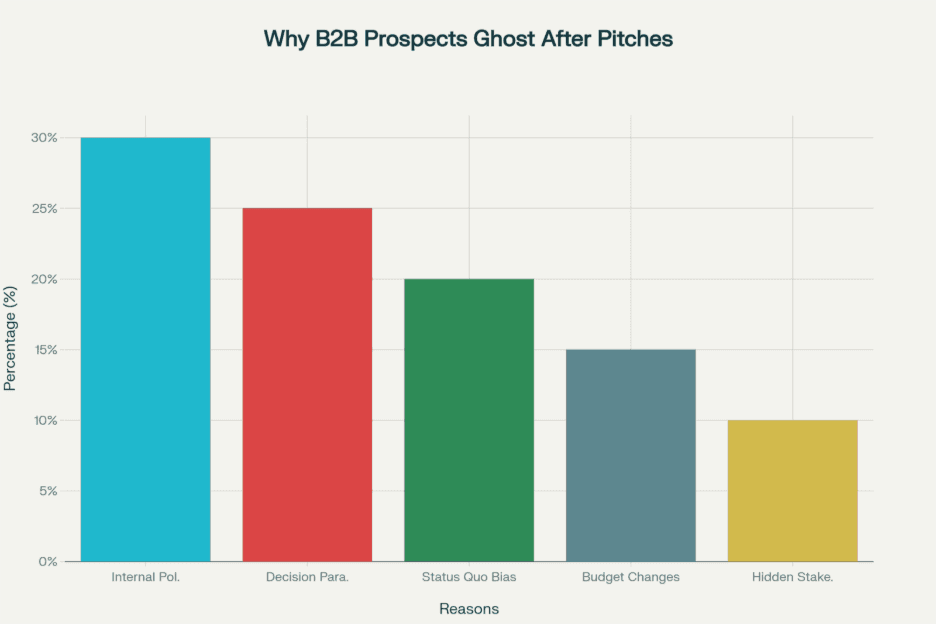
The real reasons B2B buyers' ghost after final pitches - it's not about price
The Hidden Theater of B2B Decision-Making
While you were perfecting your pitch deck, a completely different drama was unfolding inside your prospect's company. Research reveals that 40% to 60% of B2B deals end in no decision not because buyers choose a competitor, but because internal buying groups fail to reach consensus. This isn't a failure of your sales process; it's the inevitable result of complex organizational dynamics that most vendors never see coming.
The modern B2B purchase involves an average of 6 to 10 decision-makers, each with their own agenda, concerns, and political considerations. But here's where it gets interesting: the people who ultimately kill deals often aren't the ones sitting in your presentation. They're the "hidden buyers" stakeholders from finance, legal, procurement, and operations who wield enormous veto power despite leaving no digital footprints in your CRM.
These hidden influencers operate with a completely different value system than your visible champion. While your champion cares about features, innovation, and transformational potential, hidden buyers are obsessed with risk mitigation, brand recognition, and peer validation. They ask themselves: "Will this decision make me look smart or reckless? What happens if something goes wrong? Is there social cover if someone challenges this move?"2. Building the Moodboard and Direction
The Four Psychological Killers of B2B Deals
Decision Paralysis: When Choice Becomes Chaos
Your buyer isn't avoiding a decision because they're lazy, they're drowning in choice paralysis. The paradox of choice, identified by psychologist Barry Schwartz, shows that while options theoretically enable better outcomes, they also lead to higher levels of indecision, dissatisfaction, and anxiety.
In B2B contexts, this paralysis is magnified because decisions impact not just business outcomes, but personal relationships, career trajectory, and social standing within the organization. When facing multiple vendors with seemingly similar capabilities, buyers often freeze not because they can't identify the best solution, but because they're terrified of making the wrong choice.
Fear isn't rational, it's visceral. Decision-makers would rather maintain an imperfect status quo than risk being blamed for a failed initiative. This explains why deals that seem like "slam dunks" suddenly evaporate without explanation.
Status Quo Bias: The Invisible Competitor
Your biggest competitor isn't another vendor it's your prospect's comfort zone. Status quo bias occurs when the current baseline is taken as a reference point, and any change is perceived as a potential loss. This bias is particularly deadly in B2B scenarios because decisions are made by groups and groups naturally default to the safest, most familiar option.
Research shows that this bias becomes even more powerful when multiple stakeholders are involved. While one or two champions may be driving for change, others in the buying committee have higher risk tolerance thresholds or may stand to lose if the deal moves forward think IT teams who'll have to implement new technology or operations managers whose workflows will be disrupted.
The status quo isn't just preferred, it's actively defended by psychological mechanisms that make change feel threatening, even when staying put is objectively riskier.
Internal Politics: The Shadow Game
Behind every B2B purchase lies a web of office politics that can make or break deals regardless of business merit. These aren't just personality conflicts, they're systematic power dynamics involving budget control, departmental territories, and personal career considerations.
Access to decision-makers is often controlled by political gatekeepers whose approvals depend more on personal relationships and hidden agendas than on business logic. Mixed messages emerge when departments can't align on priorities, and deals get caught in the crossfire of internal conflicts that have nothing to do with your solution.
Perhaps most damaging is when procurement or finance departments exercise hidden veto power late in the process, introducing new criteria or concerns that weren't part of the original evaluation. These stakeholders often emerge from nowhere, armed with questions about vendor stability, integration complexity, or total cost of ownership that can derail months of relationship building.
Fear-Driven Risk Aversion
Corporate decision-making has become increasingly fear-driven, with executives more concerned about avoiding blame than capturing opportunity. This manifests as an obsession with "safe" choices vendors that are known quantities, even if they're not the best solutions.
Hidden buyers are 70% more likely to reject brands that aren't well-known to their peers and 31% more likely to reject brands they don't personally recognize. This brand bias explains why startup vendors with superior solutions often lose to established players with inferior offerings. The buying committee values consensus and political safety over innovation.
The Anatomy of a Ghost Deal: What Really Happens
When your champion goes silent, here's what's likely unfolding behind the scenes:
Week 1-2: Your champion attempts to build internal consensus but encounters unexpected resistance from hidden stakeholders who weren't involved in the evaluation process. Finance raises concerns about budget timing. Legal questions contract terms that seemed straightforward. IT worries about integration complexity.
Week 3-4: Internal meetings become contentious as different departments advocate for conflicting priorities. Your champion, lacking the political capital to override objections, begins to distance themselves from the initiative to avoid career damage.
Week 5-6: The buying committee enters decision paralysis. Rather than making a choice that someone might later criticize, they default to inaction. Your once-enthusiastic champion becomes unresponsive, not because they've lost interest, but because they've lost internal battles you never knew were being fought.
Breaking Through the Ghost Zone: What Elite B2B Marketers Do Differently
The agencies that consistently win in this environment understand a fundamental truth: you're not just selling a solution you're orchestrating consensus across a complex political system. Here's how the best B2B marketers adapt:
Map the Invisible Committee: They identify hidden stakeholders early through systematic discovery questions: "Who else will need to weigh in? What concerns might legal/finance/IT have? Who has veto power even if they can't approve?"
Build Parallel Influence Tracks: Instead of single threading through one champion, they develop relationships across multiple departments, understanding that each stakeholder group has different value drivers and risk concerns.
Address Political Risk Proactively: They provide champions with internal "sell sheets," competitive comparisons, and risk mitigation frameworks that make it easier to advocate internally. They understand that deals aren't won when the champion loves you, they're won when the champion can successfully sell you inside their organization.
Leverage Brand for Hidden Buyer Validation: They invest in brand building and thought leadership specifically to reach hidden buyers who don't engage with traditional marketing content but heavily influence final decisions.
Create Consensus, Not Just Conversion: Rather than optimizing for individual stakeholder approval, they orchestrate experiences that build collective buy-in across the entire buying committee.
The New Rules of B2B Influence
The days of selling to individuals are over. Today's B2B marketers must become behavioral psychologists, political strategists, and consensus builders all at once. The deals you win won't be the ones with the best features or lowest price they'll be the ones where you successfully navigate the hidden dynamics that actually drive enterprise decisions.
At Marketives, we've built our entire approach around these invisible forces. We know that behind every ghost deal is a story of internal politics, psychological barriers, and hidden stakeholders that traditional marketing approaches never address. Our clients win because we don't just create compelling pitches, we build consensus across complex organizational systems.
The next time a deal goes silent, resist the urge to blame your pricing or positioning. Instead, ask yourself: Did we map the real decision-making process? Did we address the political risks our champion faces? Did we build credibility with hidden buyers who value brand recognition over product innovation?
The truth about B2B ghosting isn't comfortable, but it is actionable. The vendors who acknowledge these hidden dynamics and systematically address them will capture the deals that their competitors will never understand they lost.
Because in B2B marketing, the most dangerous competitor isn't the one you see coming, it's the internal resistance you never knew existed.