The Art of Making Bold Marketing Decisions with Incomplete Data
Have you ever stared at a report, waiting for that one missing number to tell you whether to move left, or right? The truth is, that number rarely shows up. Business doesn’t pause until all the information is neatly lined up, it keeps moving. And so must the people lead it.
The real skill lies in making bold decisions when the picture is blurry, when you don’t have the full map and when waiting could cost more than acting.
Why Waiting for “Perfect” Data Doesn’t Work
On paper, it feels safer to hold off until the data is complete. But here’s the catch: by the time it’s complete, the opportunity may already be gone. Competitors may have moved, markets may have shifted and customers may have made their choices.
Data is important, but it is never the whole truth. It gives you signals, not guarantees. Boldness comes from recognizing that you’ll almost always have to act with less than 100% clarity and still find a way to move forward.
The Tension Between Risk and Reward
Every bold decision carries a little risk. Launching a campaign without full visibility, shifting resources when forecasts are shaky, or experimenting with a new channel when the evidence is thin can all feel like stepping into the unknown.
But there’s also a hidden risk in doing nothing. Playing it safe can mean missed momentum, loss of relevance, or worse, getting outpaced by someone else who was willing to take the leap. The art is in asking: which risk hurts more being wrong, or standing still?
Building Confidence When the Future Feels Foggy
Confidence isn’t about predicting every twist and turn, it’s about moving forward even when the road ahead is unclear. The best leaders don’t wait for certainty; they create momentum with what they have, trusting that clarity will sharpen along the way. This type of confidence comes from building strong anchors that keep decisions steady, even in the midst of ambiguity.
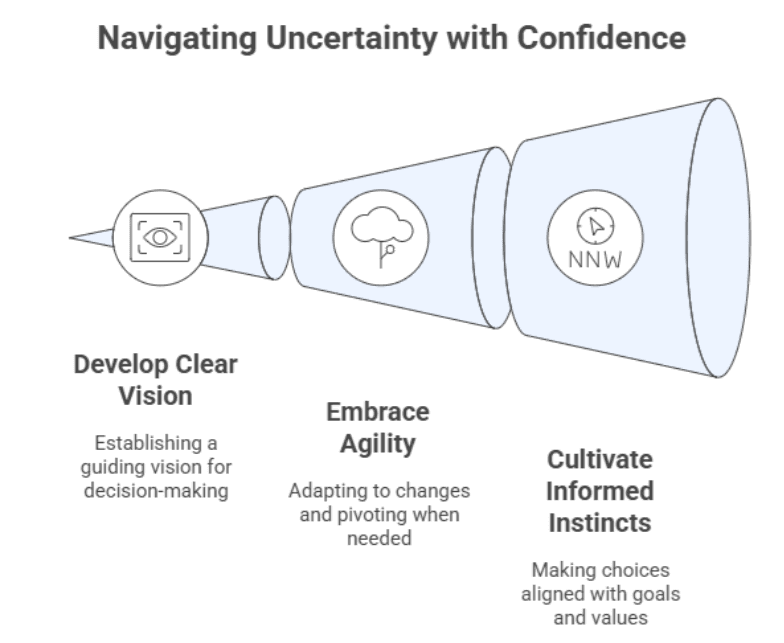
A Clear Vision
When circumstances are uncertain, vision becomes the compass. Leaders who thrive in volatile times never lose sight of the “why” behind their actions. They know the bigger picture, the long-term mission, the desired impact, the non-negotiable values guiding their path. This allows them to pivot on how they reach the goal without losing track of where they’re going. Without vision, every obstacle feels like a dead end; with vision, each obstacle is simply a detour.
Agility in Action
Rigid plans collapse under shifting conditions, but agile ones bend and adapt. Leaders who embrace flexibility don’t see change as a disruption they see it as part of the process. Instead of betting everything on a single, long-term roadmap, they break strategies into shorter cycles, with room for quick adjustments. This doesn’t mean abandoning structure it means building systems that can absorb shocks without losing balance. Agility creates the freedom to test, learn and correct courses without halting progress.
Informed Instincts
Numbers are powerful, but they rarely tell the whole story. That’s where intuition comes in not guesswork, but informed instincts built on years of experience, customer interaction and market observation. Leaders who excel in uncertainty blend data with human judgment. They listen closely to customer signals, pick up subtle market shifts and rely on pattern recognition that no algorithm can fully replicate. Informed instincts bridge the gap between what the data shows and what the future might hold.
A Real-World Glimpse
Imagine a company set to launch a new product just as market conditions turn volatile. The forecasts are unreliable, consumer behavior is shifting and the data feels more like smoke than a compass. The easy choice? Delay.
Instead, the leadership chooses a phased launch. One region first, then another, learning as they go. It’s not about ignoring the uncertainty, it’s about acting with conviction while leaving room for course correction. Months later, that decision positioned them ahead of competitors who were still waiting for clarity that never came.
Turning Ambiguity into Strength
Uncertainty doesn’t have to be a barrier it can be fuel. Acting faster uncovers insights before anyone else. Testing in the market generates real data, not theoretical predictions. And a willingness to adapt quickly reduces the cost of mistakes.
The future is rarely a straight road. But those who see ambiguity as a navigable landscape rather than a wall often find opportunities hidden in the fog.
Courage Over Certainty
Bold decisions are not about recklessness; they’re about courage. Courage to step forward with partial answers. Courage to adjust when reality shifts. And courage to accept that clarity often comes after action, not before it.
The art isn’t in having the perfect dataset. It’s in knowing when waiting is riskier than moving and having the confidence to make the call anyway.
A 3-Step Framework to Decide Boldly
When the data is incomplete, leaders don’t need perfect certainty—they need a system that balances courage with control. Here’s how to apply it:
Clarify the Why
Every bold move must connect back to a bigger purpose. Before deciding, ask: If this works, what larger goal does it help us achieve? This clarity ensures decisions aren’t just reactive responses to market noise but intentional steps toward a meaningful direction. For example, launching a campaign without full data may still be worth it if it strengthens customer trust, opens a new market segment, or accelerates brand visibility. If the “why” is powerful, the “how” can always be adjusted along the way.
Shrink the Bet
Boldness doesn’t mean gambling the entire strategy, it means acting decisively while managing risk. Instead of going all-in, break the decision into smaller, testable steps. This could look like:
Running a pilot in one region before scaling nationwide.
Testing messaging through A/B campaigns before a full rollout.
Launching in phases to gather real-world feedback quickly.
By shrinking the bet, you create room for fast learning while limiting potential losses. You keep momentum alive without staking everything on a single throw of the dice.
Set the Checkpoints
Every bold move need checkpoint moments where you pause, assess and decide whether to double down, pivot, or pull back. These checkpoints act like guardrails, preventing boldness from slipping into recklessness.
For instance:
Define what early success looks like (customer adoption, engagement rates, or sales lift).
Identify warning signs that signal the need for adjustment.
Set timelines for review so decisions don’t drift without accountability.
This approach transforms big, uncertain leaps into controlled experiments. You’re still acting courageously, but you’re building a system to learn and adapt along the way.
Therefore, bold marketing decisions aren’t about chasing certainty they’re about moving with clarity, courage and control when certainty isn’t possible. The leaders who win aren’t the ones who wait for perfect data, but the ones who act with conviction, learn along the way and turn uncertainty into momentum.
The fog will always be there the question is, will you step forward anyway?